“If the only tool you have is a hammer, it is tempting to treat everything as if it were a nail.”
There is a strong tendency for leaders to jump into the decision-making process without spending enough time in ‘problem space’ (thanks Rasmus).
At a fundamental level leaders need to consider the problem on a spectrum between complicated and complex.
Complicated problems have answers, they have a cause and an effect, if we gather enough data, we can understand the problem, identify the necessary actions and be skilled enough to deliver the actions that will result in a solution. Heart surgery is an example of a complicated problem.
At the other end of the spectrum are complex problems, which relate to the unpredictable interplay between many variable factors.
Complex problems require a certain leap of faith – or judgement as we can never prove that the proposed solution will definitely work. Child poverty would be an example of a complex problem.
Critical to understanding complex problems is the importance of metaphor, analogy or story.
Complex problems, by their very nature, are difficult to explain or comprehend. They are essentially a system where one element, connects, to another, which connects to another, and on and on, not necessarily in an identical manner each time it occurs.
Any complex problem will have elements of complication about them, i.e. there will be elements we can study, collect data and make reasonable predictions. From a Ceannas perspective the Scientist lens helps in this analysis.
However, the temptation to remain in the ‘comfort zone’ of predictability often prevents leaders from embracing the true complexity of the problem – in others words they think that if they can hit the problem hard enough with the hammer of knowledge, data, evidence and proof, the problem will gives itself up to them.
This is where wise leadership enters the arena, for it takes a wise person to appreciate that there might be no definitive answer to the problem they are facing. There can be no absolute proof that any solution will work. There can be no certainty that they will get it right.
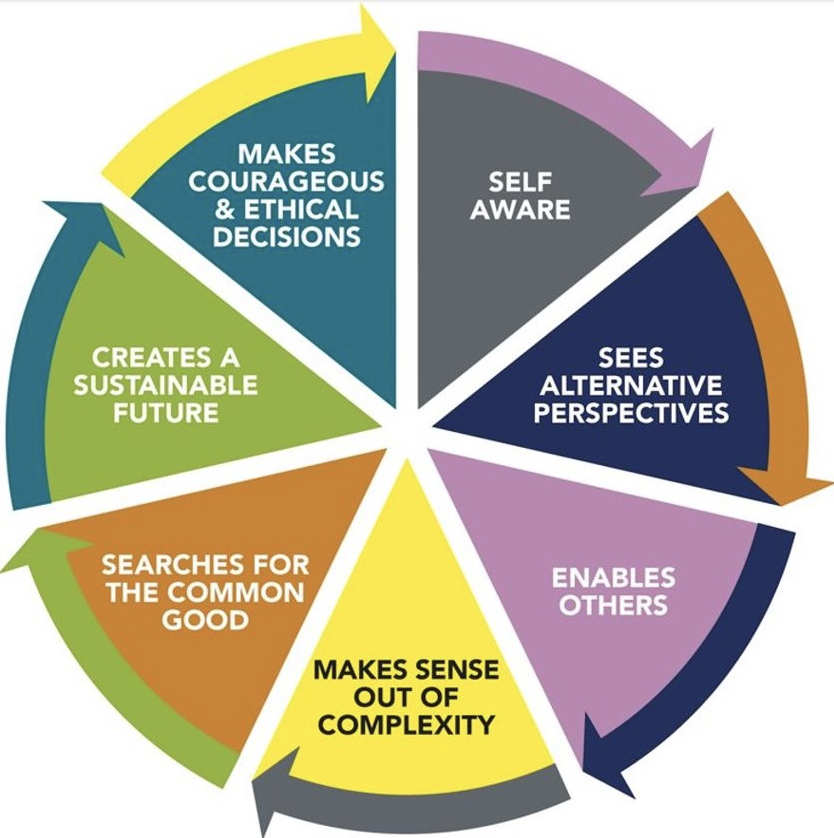
From a leadership perspective the leader needs to adopt the Sculptor lens to create a mental model that represent the problem in manner which helps them, and others, to understand the problem and identify and support a possible solution.
Of course, Wise leaders might involve others, in the creation of that mental model. We had a great example of this on Wednesday when a group of leaders were exploring the concept of trust within their business.
They generated three mental models, Lego Bricks that are distributed, used to build things, deconstructed and then re-shared with others.
The second was the London Underground which allows people to share and follow an abstract map that allows them to plan journeys.
The third mental model was of a jazz band. Where musicians are all experts, they are bound together by an overall structure to the music, they can improvise and adapt within that structure, the leader can give way to there to lead, and it maximises the capacity of each member of the band.
The jazz band model has much going for it as it captures the nature of the business in question and reinforces the importance of innovation and teamwork within a structure where people are trusted to use their initiative.
Such a mental model then informs the behaviour of the senior leadership team as they consider how their own actions either contribute towards or disable that overall goal.
Of course, the jazz band model, also needs reference to the complicated end of the spectrum as there will be hard facts that can be scrutinised and systems out in place to support the solution.
Of course, the wise solution to the problem relies upon the other components of the wheel of wise leadership.
But if we treat every problem only as a complicated problem, we will spend all our time gathering data and information in the forlorn hope that it will prove our solution will work, which brings to mind Abraham Maslow’s famous quote:
“If the only tool you have is a hammer, it is tempting to treat everything as if it were a nail.”